Why consistency—not just technical expertise—is becoming a critical component of effective healthcare technology management
A well-run in-house Healthcare Technology Management (HTM) program is built on skilled technicians, strong clinical relationships, and a commitment to keeping medical equipment safe, reliable, and available.
But technical expertise alone does not eliminate operational risk.
In today’s acute care environment, HTM departments are responsible for increasingly complex fleets of medical devices, sophisticated technology ecosystems, cybersecurity concerns, regulatory requirements, and growing expectations for measurable performance. At the same time, many hospitals continue to operate decentralized HTM programs in which processes can vary by department, facility, technician, or equipment category.
That variability can create a risk that is easy to overlook:
The organization may have good practices—but not necessarily a consistently controlled process.
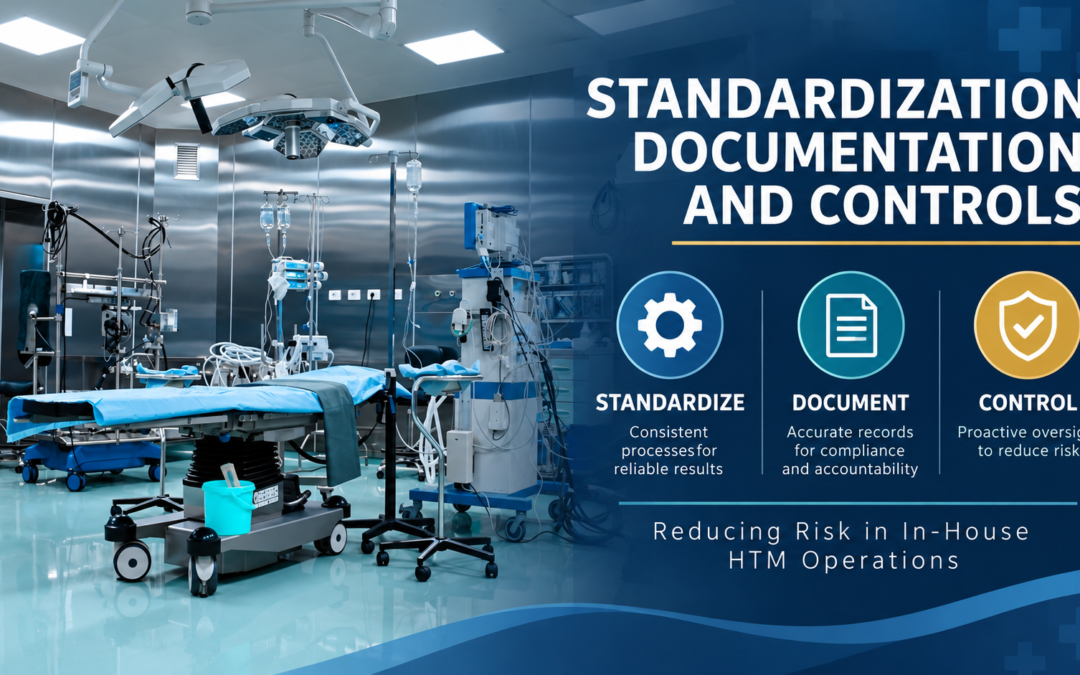
Standardization, documentation, and operational controls provide the framework that turns individual expertise into a repeatable, auditable, enterprise-level HTM program.
When “We’ve Always Done It This Way” Becomes a Risk
In-house HTM programs frequently evolve organically.
A technician develops an efficient troubleshooting process. A department creates its own equipment intake procedure. Another facility develops a different planned maintenance workflow. Over time, these practices can become accepted as the “normal” way of doing business.
Individually, each approach may work.
The problem emerges when those approaches are different.
Consider a multi-hospital health system where:
- One facility documents corrective maintenance in greater detail than another.
- Planned maintenance procedures differ for the same equipment model.
- Equipment ownership or departmental responsibility is inconsistently defined.
- Service documentation varies by technician.
- Loaner and rental equipment processes are handled differently across locations.
- Recalls are managed manually in one department but systematically in another.
- Equipment acceptance testing is documented inconsistently.
- Escalation procedures depend upon individual experience rather than defined policy.
None of these issues necessarily represents an immediate patient-safety event.
But collectively, they create variation—and variation creates risk.
Standardization Is More Than Having a Policy Manual
A common misconception is that standardization means creating more policies and procedures.
It doesn’t.
Effective standardization means establishing a common operating framework that defines what must happen, who is responsible, what documentation is required, and how compliance is verified.
A strong HTM operating model should establish consistent standards for areas such as:
Planned Maintenance
PM procedures should be based on equipment type, manufacturer requirements, risk, clinical application, and organizational policy—not simply on the individual technician performing the work.
The objective is not merely to achieve a high PM completion percentage.
It is to ensure that the same standard of care is consistently applied.
Corrective Maintenance
Repair documentation should provide enough information to establish what happened, what was found, what was performed, what parts were replaced, and whether the equipment was returned to service safely.
“Repaired—working properly” may close a work order.
It does not necessarily create an adequate service history.
Equipment Acceptance
New, rented, loaned, or transferred equipment should enter the clinical environment through a controlled process.
That process should address appropriate inspection, electrical safety where applicable, functional verification, asset identification, inventory entry, documentation, and—when appropriate—network or cybersecurity considerations.
Recalls and Safety Alerts
The ability to identify affected equipment, determine its location, document actions taken, and demonstrate closure is essential.
A recall process should not depend upon someone remembering to check an email.
Equipment Removal and Retirement
Retiring equipment is also an HTM control.
Organizations should be able to demonstrate when equipment was removed from service, why it was retired, how data-containing devices were handled, and how the asset record was appropriately updated.
Documentation Is the Evidence Behind the Process
Policies establish expectations.
Procedures establish how work is performed.
Documentation demonstrates that the work actually occurred.
This distinction becomes particularly important during regulatory surveys, accreditation reviews, internal audits, incident investigations, and leadership reviews.
A hospital may confidently state that it performs planned maintenance according to established procedures.
The more important question is:
Can the organization demonstrate it?
A mature HTM program should be able to produce reliable evidence showing:
- What equipment is in the inventory
- Where it is located
- Who is responsible for it
- What maintenance is required
- When maintenance was performed
- Who performed the work
- What was found
- What corrective action was taken
- What parts were used
- Whether the equipment was returned to service
- Whether required follow-up occurred
This is where the CMMS becomes much more than a work-order system.
When properly configured and governed, it becomes the system of record for the organization’s medical equipment lifecycle.
The “One Source of Truth” Principle
One of the most important controls for an enterprise HTM program is maintaining a reliable equipment inventory.
An organization cannot effectively manage what it cannot accurately identify.
Yet equipment inventories can deteriorate surprisingly quickly.
Equipment moves between departments. New devices arrive. Older devices are retired. Facilities merge. Departments reorganize. Equipment is loaned, rented, transferred, or replaced.
Without disciplined inventory controls, the CMMS can gradually become disconnected from reality.
A mature HTM program therefore treats asset data as an operational asset.
Key controls should include:
Asset identification → Ownership → Location → Risk classification → Maintenance requirements → Service history → Lifecycle status → Retirement
When these elements are consistently maintained, leadership gains something extremely valuable:
confidence in the data used to make operational and capital decisions.
Consistency Across Technicians Matters
One of the greatest strengths of an experienced HTM department can also become a potential weakness: institutional knowledge.
Experienced technicians often know how to solve problems that are not explicitly documented.
That knowledge is valuable—but if critical processes exist primarily “in someone’s head,” the organization has created a dependency on individuals rather than on systems.
A resilient HTM organization asks:
“Could another qualified technician perform this process correctly using our established documentation?”
If the answer is no, the process may need greater standardization.
This does not mean eliminating professional judgment.
Quite the opposite.
Standardized processes establish the baseline, allowing technicians to apply professional judgment when exceptions occur—and document those exceptions appropriately.
Controls Should Be Built Into the Workflow
The strongest HTM controls are not necessarily additional approval steps or administrative checkpoints.
They are controls embedded directly into the workflow.
For example:
- Required fields prevent incomplete work-order closure.
- Standardized PM templates reduce technician-to-technician variation.
- Defined equipment classifications establish consistent maintenance requirements.
- Automated alerts identify overdue PMs or unresolved recalls.
- Approval workflows establish accountability for equipment disposition.
- Dashboard reporting identifies exceptions before they become systemic problems.
- Role-based access protects the integrity of critical asset information.
The goal is simple:
Make the right process the easiest process to follow.
From Department-Level Practices to Enterprise Governance
For single-hospital organizations, standardization is important.
For multi-hospital health systems, it becomes essential.
An enterprise may have hundreds of thousands of assets distributed across hospitals, ambulatory facilities, specialty departments, and geographically dispersed locations.
The answer is not necessarily to force every location to operate identically.
Instead, organizations should establish an enterprise standard with controlled local variation.
Think of it as:
One standard.
One governance framework.
One source of truth.
Appropriate local flexibility.
For example, an enterprise may establish a common standard for PM documentation while allowing specific equipment classes or clinical environments to have specialized procedures.
This preserves operational flexibility without sacrificing governance.
Five Questions Every In-House HTM Leader Should Ask
HTM leaders evaluating their current operating model should consider five fundamental questions:
- Are our processes documented—or simply understood?
If a process depends upon institutional knowledge, determine whether that knowledge should be converted into a formal procedure, workflow, or decision tree.
- Would two technicians perform the same process the same way?
If not, determine whether the variation is intentional and controlled—or simply historical.
- Can we prove that our processes are being followed?
Policies without measurable compliance are difficult to govern.
- Can leadership trust the data in the CMMS?
If asset counts, locations, ownership, maintenance history, or equipment status are inaccurate, downstream decisions will also be compromised.
- What happens when an experienced employee leaves?
A strong HTM program should retain organizational knowledge even when individuals change roles, retire, or leave the organization.
The Goal: A Repeatable, Defensible HTM Program
Standardization should never become an exercise in creating paperwork for its own sake.
The objective is much more important.
A mature HTM program should be:
Consistent enough to control risk.
Flexible enough to support clinical operations.
Documented enough to demonstrate compliance.
Measured enough to identify exceptions.
Governed enough to improve over time.
This is the difference between an HTM department that primarily performs maintenance and an HTM organization that manages healthcare technology risk.
In-house HTM programs already possess tremendous technical expertise.
The next opportunity is to build the operational infrastructure around that expertise—standardizing critical processes, strengthening documentation, establishing meaningful controls, and creating visibility across the entire enterprise.
Because when the process is consistent, the data is reliable, and accountability is clear, healthcare organizations are better positioned to protect patients, support clinicians, control costs, and manage technology throughout its lifecycle.
Standardization isn’t about taking judgment out of HTM.
It’s about creating the controls that allow professional judgment to work within a reliable system.
How ISS Solutions Can Help
For healthcare organizations evaluating the maturity of their in-house HTM operations, ISS Solutions can provide an objective perspective on the policies, processes, technology, data, and controls that support the program.
Through HTM assessment, operational consulting, CMMS optimization, equipment inventory management, lifecycle planning, and enterprise HTM support, ISS Solutions helps healthcare organizations transform individual practices into consistent, measurable, and sustainable HTM processes.
The result is an HTM program designed not only to maintain equipment—but to provide healthcare leadership with greater visibility, accountability, and control over medical technology risk.
Let’s take a closer look at your HTM operation. Contact ISS Solutions to discuss an HTM assessment or learn how our consulting and technology solutions can help create a more consistent, measurable, and sustainable program.