
How SLAs and KPIs work together to turn an outsourced HTM contract into a measurable partnership.
A dashboard shows 99% PM compliance, and everything looks on track. But is that the whole story? Whether a healthcare organization is outsourcing its entire Healthcare Technology Management (HTM) operation, supplementing an in-house team, or moving from a fragmented vendor model to an enterprise program, leadership needs a clear way to evaluate performance and value. A single headline number rarely provides it.
Look beyond the headline number
A 99% PM compliance rate, on its own, doesn’t tell you much. It shows how many scheduled tasks were completed, but not whether every applicable asset and critical device is included, or whether exceptions are documented consistently. If the CMMS inventory is incomplete or out of date, the percentage can look strong while assets go unmanaged. A completed PM also only matters if its findings are addressed, tracked and closed out. A KPI is only as meaningful as the data, definitions and methodology behind it, so ask how the number is calculated before deciding what it means. That starts with understanding the difference between SLAs and KPIs.
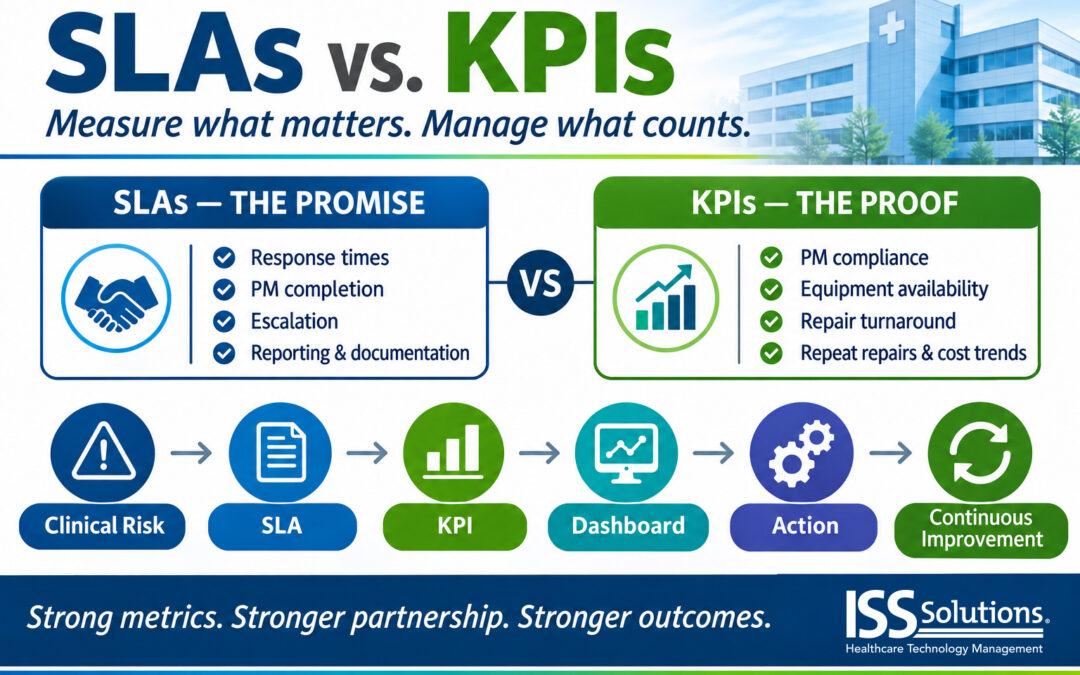
SLAs set the expectation. KPIs show the result.
A Service Level Agreement (SLA) defines the service a provider is obligated to deliver—such as response times, planned maintenance completion, escalation, documentation and reporting. Key Performance Indicators (KPIs) measure how the program is actually performing, including PM compliance, repair turnaround time, equipment availability, first-time fix rate, repeat repairs and open work-order aging.
The distinction is important: SLAs establish expectations; KPIs provide evidence.
Measure the health of the whole program
Effective HTM performance management uses a balanced set of measures—not a single percentage. Healthcare leaders should consider:
- PM compliance and overdue exceptions
- Corrective maintenance response aligned with clinical priority
- Repair turnaround time and equipment downtime
- Equipment availability for clinical use
- First-time fix rate and repeat repairs
- Open work-order aging and reasons for delay
- Recall and safety-alert action, completion and documentation
- Parts, service-cost and lifecycle trends
Viewed together, these measures can reveal patterns that an isolated metric may miss. Strong PM compliance, for example, can coexist with rising repeat repairs, downtime and equipment age—potential signs of lifecycle risk.
To explore a full KPI framework, see our white paper: Understanding SLAs and KPIs in Outsourced HTM.
Make reporting actionable
Dashboards should be designed for their audience. Technicians need work assignments, priorities and equipment history. HTM managers need compliance, backlog, repair turnaround and availability trends. Executives need program risk, cost trends, capital requirements, major exceptions and strategic opportunities.
Quarterly Business Reviews should go beyond presenting indicators. They should explain what happened, why it happened, what it means and what actions will follow. The goal is to move from reporting activity to managing performance.
From vendor oversight to measurable partnership
The strongest outsourced HTM relationships align service levels with clinical risk, define scope and accountability before service begins, and use consistent reporting, trend analysis, root-cause review and corrective action to drive continuous improvement. The right question is not simply whether the provider completed the work. It is whether the program is improving equipment reliability, availability, safety and lifecycle management.
How ISS Solutions can help
ISS Solutions helps healthcare organizations build measurable HTM programs through experienced HTM support, structured processes, CMMS technology, data analytics, equipment lifecycle management and executive-level reporting. The objective is to give healthcare leadership visibility and confidence that medical technology is being managed—not simply maintained.
The right SLA defines the promise. The right KPI proves the performance. The right HTM partner makes both meaningful.
See the full story behind your HTM metrics
Download Understanding SLAs and KPIs in Outsourced HTM and learn how to:
- Monitor the eight performance areas that give a balanced view of your HTM program
- Confirm how KPIs are calculated, including numerator, denominator and asset coverage
- Align service levels with clinical risk, not one-size-fits-all expectations
- Make quarterly reviews a management discipline, not a dashboard of green, yellow and red
Download the white paper: [Understanding SLAs and KPIs in Outsourced HTM]