Most healthcare organizations have talented HTM professionals and strong maintenance programs.
But as medical technology environments become more complex, connected, and distributed, technical expertise alone is no longer enough.
HTM leaders should be asking themselves:
- Can we trust our asset data?
- Are processes performed consistently across facilities?
- Can we demonstrate compliance?
- Do we have visibility into medical technology risk?
- How dependent are we on institutional knowledge?
The answers often come down to three foundational elements:
- Standardization
- Documentation
- Operational Controls
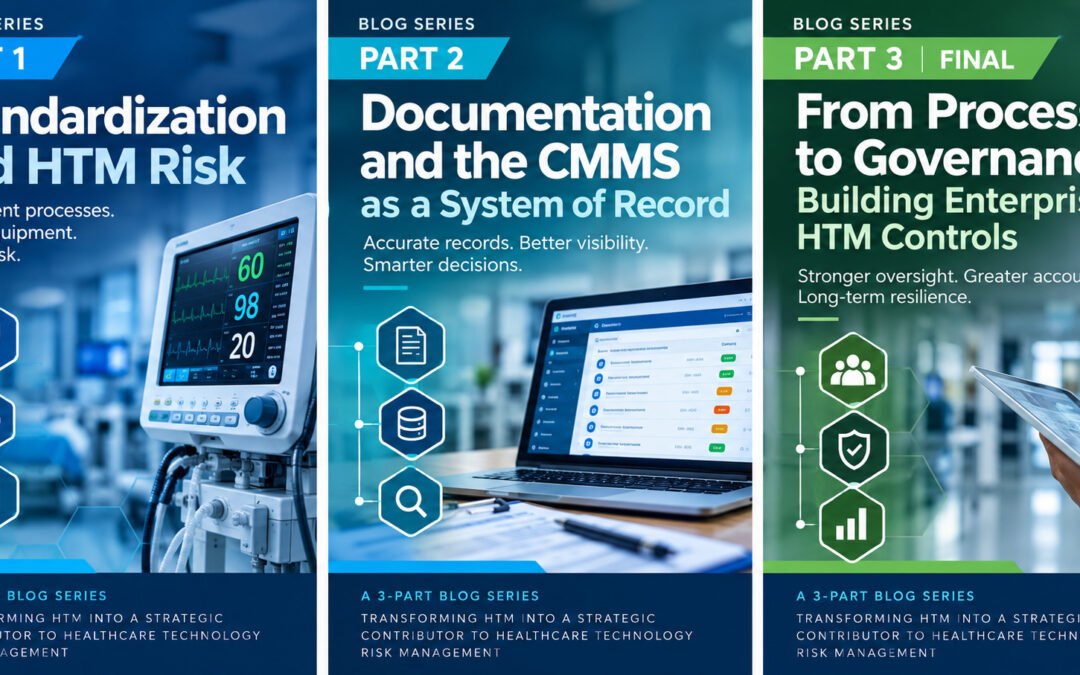
Over the next several weeks, we will be sharing a three-part series exploring how these disciplines help transform HTM from a maintenance function into a strategic contributor to healthcare technology risk management.
Part 1: Standardization and HTM Risk
Part 2: Documentation and the CMMS as a System of Record
Part 3: From Process to Governance: Building Enterprise HTM Controls
This series provides practical insights for HTM leaders seeking to improve consistency, strengthen accountability, and build more resilient technology management programs.
#HTM #ClinicalEngineering #HealthcareTechnologyManagement #BiomedicalEngineering #HealthcareLeadership #MedicalDevices #AssetManagement #Cybersecurity #HealthcareOperations
Part 1
Standardization and HTM Risk: Why Consistency Matters More Than Ever
Most healthcare organizations have skilled HTM professionals. Not all have standardized HTM operations.
An in-house Healthcare Technology Management (HTM) program is often judged by the experience of its technicians, preventive maintenance completion rates, and ability to keep medical equipment available for clinical use.
Those capabilities are important, but they do not necessarily determine whether an HTM program is operating in a controlled, scalable, and sustainable manner.
As healthcare systems grow, technology portfolios expand, and regulatory expectations increase, one factor is becoming increasingly important:
Consistency.
Many hospitals have good practices. Fewer have consistently applied practices across every facility, department, and technician.
That distinction matters because variability creates risk.
The Hidden Risk of Process Variation
In many organizations, HTM processes evolve over time.
A technician develops an efficient troubleshooting method. One hospital creates a maintenance workflow that differs from another. Documentation standards vary by team or location. Equipment intake processes develop differently across departments.
Individually, none of these practices may be problematic.
Collectively, however, they create inconsistency.
Consider a health system where:
- PM documentation varies by facility
- Corrective maintenance records differ by technician
- Acceptance testing procedures are applied inconsistently
- Recall management processes differ between departments
- Escalation decisions depend on institutional knowledge rather than defined workflows
The organization may believe it has a sound HTM program.
The question is whether it has a consistently controlled HTM program.
Standardization Is Not Bureaucracy
When people hear “standardization,” they often think of additional policies, forms, and administrative requirements.
Effective standardization is something different.
It establishes a common operating framework that defines:
- What work is performed
- How it is performed
- Who is responsible
- What documentation is required
- How compliance is verified
The goal is not to eliminate professional judgment.
The goal is to ensure that critical processes are performed consistently regardless of location, department, or individual technician.
Why Leaders Should Care
The consequences of process variation are rarely immediate.
Instead, variation gradually creates operational blind spots:
- Inconsistent maintenance records
- Limited visibility into equipment status
- Gaps in accountability
- Difficulty demonstrating compliance
- Reduced confidence in operational data
Over time, these issues increase organizational risk and make it more difficult for leaders to make informed decisions.
Five Questions Every HTM Leader Should Ask
- Are our core processes documented?
- Would two technicians perform the same task the same way?
- Are variations intentional or historical?
- Can leadership measure compliance with established processes?
- Can we demonstrate consistency across locations?
Organizations that can answer “yes” to these questions are often better positioned to scale operations, manage risk, and support growth.
How ISS Solutions Can Help
For healthcare organizations seeking to improve consistency across their HTM operations, ISS Solutions provides objective assessments of policies, procedures, workflows, and governance structures. We help organizations identify process variation, establish standardized operating practices, and create scalable frameworks that support compliance, accountability, and enterprise-wide consistency.
Whether supporting a single facility or a multi-site health system, ISS Solutions helps transform individual practices into standardized, repeatable processes that reduce operational risk and support long-term program maturity. Contact ISS Solutions today to learn how we can help strengthen your HTM program.
In Part 2 of this series, we’ll examine why documentation and CMMS governance have become essential components of enterprise HTM programs.