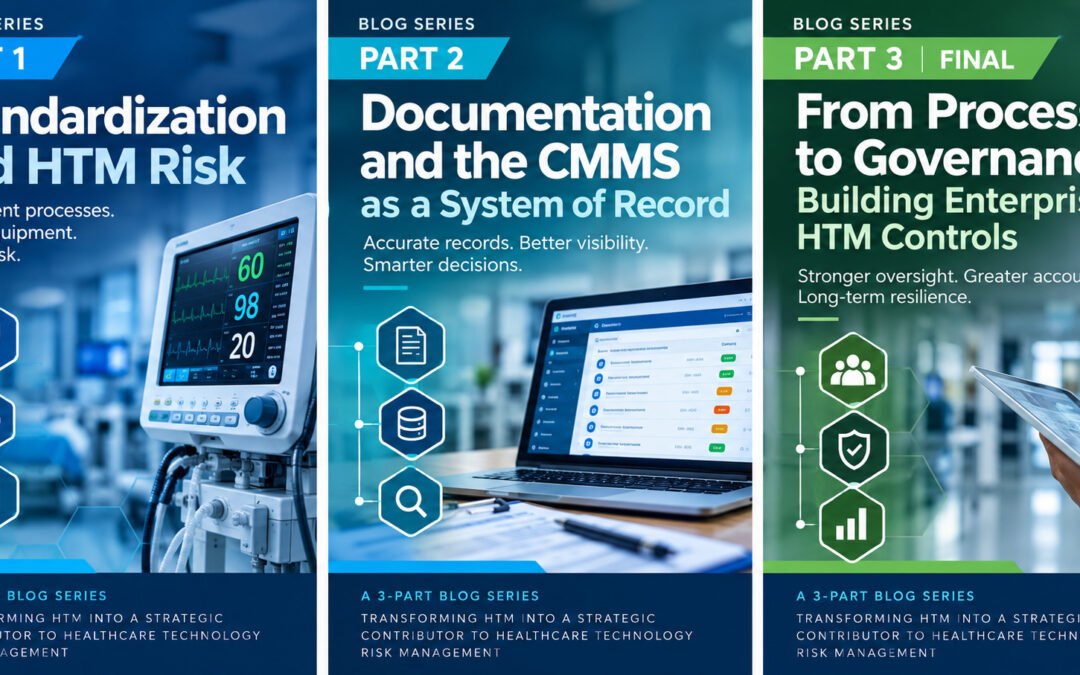
In Part 1 of our Beyond Technical Expertise series, we explored how standardization helps healthcare organizations reduce risk, improve consistency, and strengthen Healthcare Technology Management (HTM) programs.
But even well-defined processes can fall short without reliable documentation.
Accurate, consistent documentation provides the foundation for informed decision-making, regulatory compliance, accountability, and effective risk management. When information is incomplete, inconsistent, or difficult to access, HTM leaders may struggle to verify work performed, understand asset history, identify recurring issues, or demonstrate compliance across their organizations.
A Computerized Maintenance Management System (CMMS) can serve as the central system of record for this critical information—but only when documentation practices are consistent, data is reliable, and processes are followed.
In Part 2 of this series, we examine why documentation matters, how the CMMS supports stronger HTM operations, and what leaders can do to improve data integrity and organizational visibility.
Part 2: Documentation and the CMMS: Building the HTM System of Record
If documentation doesn’t exist, can the organization prove the work occurred?
Most HTM departments have policies.
Many have procedures.
The differentiator between an average program and a highly governed program is often documentation.
Policies establish expectations.
Procedures define how work should be performed.
Documentation provides evidence that the work actually occurred.
In today’s healthcare environment, that distinction matters more than ever.
Documentation Is More Than Regulatory Protection
Documentation is often viewed primarily as a regulatory requirement.
While surveys and audits certainly rely on documentation, its value extends much further.
Accurate documentation helps organizations:
- Demonstrate compliance
- Support incident investigations
- Improve operational visibility
- Establish accountability
- Manage equipment lifecycle decisions
- Support cybersecurity initiatives
Simply stated:
Documentation transforms activity into evidence.
The CMMS Is No Longer Just A Work Order System
Many organizations still view their computerized maintenance management system (CMMS) primarily as a scheduling and work-order platform.
Modern HTM programs require much more.
When properly governed, the CMMS becomes the organization’s system of record for medical technology.
Leadership should be able to answer critical questions directly from CMMS data:
- What equipment do we own?
- Where is it located?
- Who is responsible for it?
- What maintenance is required?
- What work has been performed?
- Which assets are approaching replacement?
If those answers cannot be obtained quickly and reliably, additional governance may be needed.
The “One Source of Truth” Challenge
One of the most common problems in healthcare technology management is inventory drift.
Equipment moves.
Departments change ownership.
Facilities merge.
Assets are retired.
New devices are introduced.
Without disciplined controls, the CMMS gradually becomes less accurate over time.
Once confidence in the data is lost, decision-making suffers.
Capital planning becomes more difficult.
Cybersecurity visibility decreases.
Compliance efforts become more resource intensive.
Operational reporting becomes less reliable.
Asset Data Is a Strategic Resource
Leading organizations treat asset information as a strategic asset.
Core elements should remain accurate throughout the equipment lifecycle:
- Asset identification
- Location
- Ownership
- Risk classification
- Maintenance requirements
- Service history
- Lifecycle status
When these elements are consistently maintained, leaders gain confidence in the data supporting operational and capital decisions.
The Bottom Line
The goal of documentation is not paperwork.
The goal is visibility.
An organization’s ability to manage medical technology risk depends heavily on its ability to trust the information used to make decisions.
How ISS Solutions Can Help
The effectiveness of any HTM program depends on the quality of its data. ISS Solutions helps healthcare organizations strengthen documentation practices, improve CMMS governance, optimize asset inventories, and establish reliable equipment records throughout the technology lifecycle.
Through HTM assessments, CMMS optimization, inventory management, and data integrity initiatives, ISS Solutions helps organizations build a trusted system of record that supports operational decision-making, compliance readiness, cybersecurity initiatives, and capital planning.
In our third and final post of the series, we’ll explore how healthcare organizations can embed controls directly into HTM workflows and transition from department-level practices to enterprise governance.
Coming Next: Part 3 — From Process to Governance: Building Enterprise HTM Controls
Reliable documentation and standardized processes are essential, but how can healthcare organizations ensure those practices are consistently followed, measured, and sustained across the enterprise?
In Part 3, we will explore how HTM leaders can move beyond individual processes to establish stronger governance, accountability, and enterprise-wide controls.