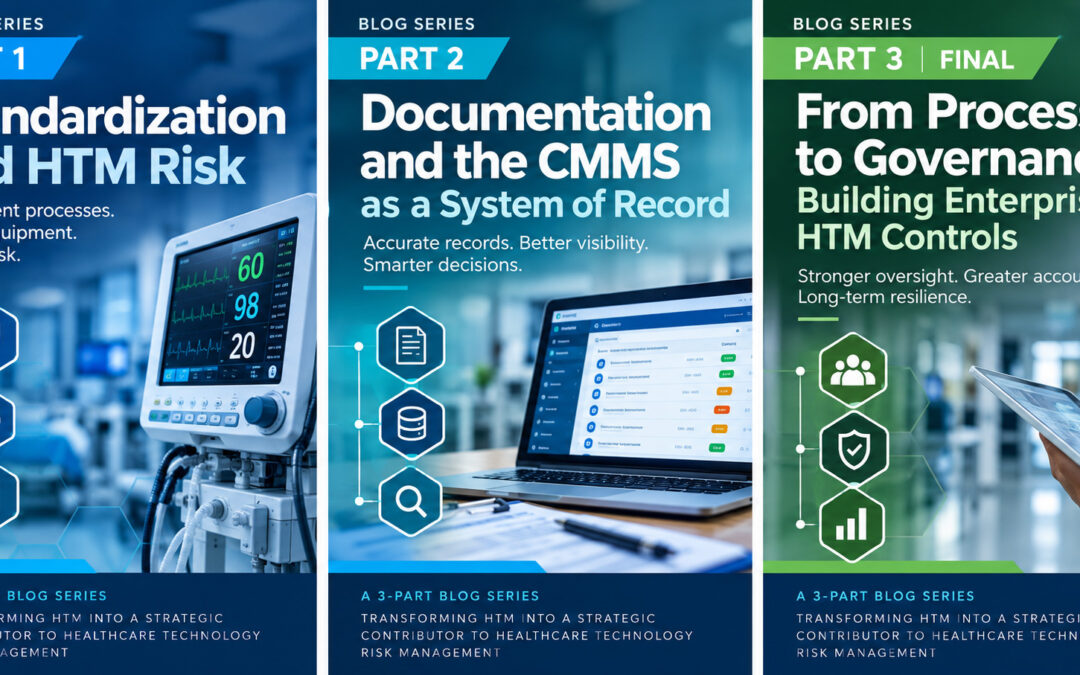
Throughout this three-part series, we have explored how standardization and reliable documentation help healthcare organizations strengthen their Healthcare Technology Management (HTM) programs. But even the best processes and documentation practices need something more: governance.
In the final installment of our Beyond Technical Expertise series, we examine how HTM leaders can move from managing processes to establishing governance structures that support enterprise-wide visibility, accountability, and risk reduction.
Part 3
From Process to Governance: Building Enterprise HTM Controls
Good HTM departments perform maintenance. Great HTM organizations manage risk.
As healthcare systems grow larger and more complex, leadership expectations for HTM continue to evolve.
Success is no longer measured only by equipment uptime or PM completion rates.
Healthcare organizations increasingly expect HTM teams to provide visibility, accountability, compliance support, lifecycle planning, and technology risk management.
Meeting those expectations requires more than skilled technicians.
It requires operational controls.
What Are HTM Controls?
Controls are mechanisms that help ensure processes are followed consistently.
The most effective controls are not additional administrative burdens.
They are embedded directly into daily workflows.
Examples include:
- Required documentation fields
- Standardized PM templates
- Automated recall tracking
- Escalation workflows
- Approval requirements for asset disposition
- Exception reporting dashboards
- Role-based system permissions
The purpose is simple:
Make the right process the easiest process to follow.
Reducing Dependence on Institutional Knowledge
Experienced technicians are among the most valuable assets within any HTM organization.
However, organizations create risk when critical processes exist primarily in individuals’ memories.
A useful question for leaders is:
Could another qualified technician successfully perform this process using documented procedures and available tools?
If the answer is no, the organization may be relying too heavily on institutional knowledge.
Strong governance ensures knowledge remains within the organization, not solely with individuals.
Enterprise Governance Versus Local Practices
This challenge becomes especially important for multi-hospital health systems.
The answer is not forcing every location to operate identically.
Instead, successful organizations establish:
- One governance framework
- One source of truth
- One set of enterprise standards
- Appropriate local flexibility
This approach allows hospitals to address unique operational needs while maintaining systemwide visibility and accountability.
Signs of a Well-Governed HTM Program
Organizations often demonstrate governance maturity when they can:
- Consistently apply processes across locations
- Measure compliance with standards
- Trust their asset data
- Track exceptions before they become problems
- Maintain continuity despite staffing changes
- Support leadership decisions with reliable information
These capabilities create resilience and reduce operational risk.
The Future of HTM
Healthcare technology continues to become more connected, more complex, and more critical to clinical operations.
As a result, HTM programs are increasingly being viewed not solely as maintenance providers but as strategic contributors to enterprise risk management.
The organizations that succeed will be those that combine technical expertise with strong governance, reliable data, effective controls, and consistent processes.
Because ultimately, the goal is not simply maintaining equipment.
The goal is creating an HTM program that provides healthcare leadership with confidence, visibility, and control.
Bringing It All Together
Standardization establishes consistency. Documentation creates reliable information. Governance ensures that processes are followed, performance is measured, and risks are managed.
Together, these three disciplines help transform HTM from a maintenance-focused function into a strategic contributor to healthcare technology risk management.
For HTM leaders, the opportunity is clear: move beyond measuring work completed to understanding risk controlled, accountability established, and organizational resilience strengthened.
Interested in evaluating the maturity of your HTM program?
ISS Solutions works with healthcare organizations to assess operational practices, documentation standards, CMMS data quality, governance structures, and technology management processes. If you’re interested in discussing opportunities to strengthen consistency, visibility, and control within your HTM program, we welcome the opportunity to connect.